
RWA Is Becoming Financial Infrastructure. The Next Race Is Bigger Than Tokenization
RWA tokenization is moving beyond digital wrappers into capital-market infrastructure. With roughly $38.6 billion in distributed assets, the next phase is being shaped by tokenized Treasuries, stocks, collateral, settlement and institutional platforms connecting blockchain with traditional finance.
The Signal — Key Takeaways
- 01Distributed RWA value is around $38.6 billion, led by U.S. Treasuries, credit and commodities.
- 02Tokenized stocks are growing fastest in user adoption, with more than 4 million holders and over $3 billion in distributed value.
- 03The market is shifting from simple asset issuance toward settlement, collateral, custody, transfer agency and regulated trading infrastructure.
- 04DTCC, Securitize, Ondo, Franklin Templeton, J.P. Morgan and NYSE are emerging as important players across different layers of the RWA stack.
- 05The strongest business opportunities may sit in private markets, treasury management, collateral mobility, compliance, interoperability and cross-border distribution.
- 06Tokenization's real test is whether it can reduce financial friction and improve capital efficiency, not simply move existing assets onto blockchains.
The next phase of real-world asset tokenization will not be decided by who puts the most assets on a blockchain.
It will be decided by who can make those assets useful.
That distinction has become much clearer in 2026. Tokenized government securities are being used as collateral. Money-market fund shares can move through blockchain-based infrastructure while continuing to earn yield. Tokenized equities can increasingly be created and redeemed against underlying shares. Central banks are beginning to provide settlement infrastructure. Existing securities depositories are moving assets already inside traditional capital markets onto blockchain rails.
The strongest signal comes from the Depository Trust & Clearing Corporation. DTCC plans to launch its DTC Tokenization Service in October 2026, after successfully converting DTC-held securities into tokens and using them in production transactions in July. DTC currently custodies more than $114 trillion of securities, giving the initiative a potential connection to pools of assets vastly larger than today's standalone RWA market.
This is where the RWA story changes.
The question is no longer whether a Treasury bill, stock, credit instrument or fund can technically be tokenized. That has already been demonstrated. The question is whether tokenization can improve how capital is issued, distributed, settled, financed, collateralized and moved between markets.
The market is already larger than the headline suggests, but still small relative to its ambition
As of September 28, the eight major distributed RWA categories tracked by RWA.xyz add up to approximately $38.6 billion, excluding stablecoins.
Distributed RWA category | Value | 30-day change | Approx. share |
|---|---|---|---|
$14.69B | -7.92% | 38.1% | |
$7.91B | +0.74% | 20.5% | |
$5.17B | +3.96% | 13.4% | |
$4.01B | +9.89% | 10.4% | |
$3.15B | +15.63% | 8.2% | |
$2.37B | +0.43% | 6.1% | |
$1.04B | -13.05% | 2.7% | |
$226M | -0.04% | 0.6% |
Share calculations use the approximately $38.6 billion combined distributed value of these RWA.xyz categories as of September 28, 2026.
The composition is more important than the total.
Tokenized real estate has dominated RWA presentations for years, yet distributed real estate accounts for only about $226 million. U.S. Treasury products are roughly 65 times larger. Credit is about 35 times larger.
The assets finding product-market fit today are largely those that already perform important financial functions: storing liquidity, producing yield, financing borrowers, serving as collateral and giving investors exposure to liquid securities.
That should matter to founders evaluating where to build.
Fractionalizing another property may be technically straightforward. Creating infrastructure that lets institutions move billions of dollars of collateral, settle securities across borders or distribute regulated funds into digital wallets addresses a much larger financial workflow.
Treasuries hold the capital. Tokenized stocks are attracting the users.
U.S. Treasury products remain the largest distributed RWA category at $14.69 billion. Ondo leads the RWA.xyz Treasury platform table with approximately $2.9 billion, followed by Franklin Templeton's Benji platform at $2.5 billion, Circle at $2.4 billion and Securitize at $2.4 billion.
Individual products are now substantial. Circle's USYC was around $2.40 billion, Ondo USDY around $2.28 billion, BlackRock's BUIDL around $2.24 billion, Franklin's iBENJI around $1.72 billion, and WisdomTree's WTGXX around $1.23 billion on September 28, according to RWA.xyz's tokenized Treasury data.
But equities are developing differently.
Tokenized stocks reached $3.15 billion, up 15.6% over 30 days. More strikingly, RWA.xyz counted 4.01 million holders, up 67.5%, and about 3.17 million monthly active addresses, up 115% over 30 days. Monthly transfer volume was $12.29 billion, although it had fallen sharply from the previous 30-day period, demonstrating that activity remains volatile.
The distinction is important for market strategy.
Treasuries are currently where much of the capital sits. Tokenized equities are becoming a distribution engine.
Ondo led RWA.xyz's tokenized-stock platform table with approximately $868 million, followed by bStocks at $763 million and xStocks at $571 million. (RWA.xyz tokenized stocks data)
Ondo's broader platform illustrates how quickly this part of the market is developing. RWA.xyz showed approximately $3.88 billion in distributed assets, more than 505,000 holders and $1.86 billion of monthly transfer volume across Ondo's RWA products.
Ondo separately says its Stocks product has passed $1 billion in TVL and $26 billion in cumulative trading volume. Those figures are company-reported rather than independent market measurements, but they demonstrate the scale the company says it has reached since launching tokenized stocks in September 2025.
More important than the headline TVL is what Ondo has started building underneath it.
In September, Ondo and Alpaca introduced an in-kind mechanism allowing approved institutions to contribute existing underlying shares and mint corresponding tokenized stocks, or redeem tokens back into shares. That gives market makers a direct bridge between conventional securities inventory and onchain inventory instead of requiring separate cash financing for every token creation.
It resembles one of the mechanisms that makes ETFs work efficiently.
That is a meaningful transition from token issuance to market structure.
The leaders are controlling different layers
There is no single RWA market leader because the market is becoming a stack.
Securitize currently has approximately $4.68 billion in distributed assets, making it larger than Ondo by this RWA.xyz platform measure. Its monthly transfer volume was approximately $852 million and had risen 50.7% over 30 days.
Its strategic position is particularly important because it sits behind institutional products including BlackRock's BUIDL and has relationships extending into private markets and traditional exchanges.
BlackRock's BUIDL alone stood at approximately $2.24 billion on September 28, according to RWA.xyz. A framework involving BlackRock, Securitize, OKX and Standard Chartered now allows qualified institutional clients to use BUIDL as yield-bearing collateral while assets remain under regulated off-exchange custody.
This is one of the most consequential RWA use cases currently in production.
A Treasury fund is no longer simply something an investor owns. It can remain invested and generating yield while functioning as collateral supporting another transaction.
Securitize is also moving deeper into private markets. ARK Invest announced on September 24 that its ARK Venture Fund would be tokenized using Securitize, providing eligible investors blockchain-based access to a portfolio that includes private and public technology companies.
RWA.xyz currently tracks approximately $2.37 billion of distributed private equity and venture capital assets, with Securitize representing about $1.2 billion of the category.
The company is also working with NYSE.
NYSE and Securitize agreed in March to develop infrastructure around an upcoming NYSE-affiliated digital trading platform, with Securitize named as the first digital transfer agent eligible under the planned programme to mint blockchain-native securities for participating issuers.
NYSE itself describes the platform it is developing as a 24/7 digital trading venue intended to combine its Pillar trading technology with blockchain settlement and stablecoin-based transactions. A public launch date has not been confirmed, so this remains an infrastructure programme rather than a live 24/7 replacement for the existing NYSE market. (NYSE discussion of its tokenized securities platform)
That distinction matters.
The competitive question is increasingly not "Who has the biggest token?"
It is "Who controls issuance, ownership records, distribution, trading, settlement and collateral?"
Traditional banks and asset managers are no longer observing from the sidelines
Franklin Templeton's Benji platform is becoming another important piece of institutional tokenization.
Franklin said its BENJI suite had $1.98 billion in assets under management by April 29, five years after launching its first blockchain-recorded U.S. government money-market fund.
Its utility has since moved beyond investment access.
Eligible institutional clients can use Benji-issued tokenized money-market fund shares as off-exchange collateral when trading on Binance, while the assets remain with regulated custody infrastructure.
J.P. Morgan is approaching the market from another direction.
Its Kinexys infrastructure supports tokenized money-market funds, digital collateral, payments and asset tokenization. RWA.xyz showed J.P. Morgan's JLTXX tokenized money-market fund at approximately $596 million on September 28. J.P. Morgan said in August that Kinexys had processed more than $4 trillion in transactions since inception and was averaging approximately $7 billion per day, although the Kinexys transaction figure covers its broader blockchain infrastructure rather than RWA issuance alone.
Its Tokenized Collateral Network illustrates the commercial logic. Institutions can transfer ownership of collateral without moving the underlying assets between conventional ledgers, potentially allowing assets to remain invested while being mobilized for financing.
State Street has also entered onchain cash management. Its SWEEP fund, developed with Galaxy, was launched to allow qualified investors to move stablecoin balances into a yield-bearing liquidity product designed for 24/7 onchain cash management.
Taken together, these projects point toward an important evolution.
Tokenization is beginning to compete with idle capital.
That is a much larger opportunity than simply competing with cryptocurrency products.
What this means for businesses
For boards and executive teams, RWA should increasingly be viewed through operating economics rather than blockchain terminology.
The first opportunity is treasury and liquidity management.
Corporate cash frequently sits across bank accounts, money-market funds, collateral accounts, exchanges and custodians. Moving between those environments creates settlement windows, reconciliation work and periods where capital cannot be deployed elsewhere.
Tokenized money-market products create the possibility of keeping capital in a yield-generating instrument while making it more transferable and potentially usable as collateral.
The second opportunity is capital formation and distribution.
Tokenization can give asset managers, private-market funds and issuers a digital distribution layer capable of reaching investors through wallets, platforms and multiple blockchain networks. Private equity and venture capital remain relatively small at $2.37 billion of distributed value, but Securitize's leadership in the category and ARK's decision to tokenize ARKVX indicate that private markets are moving into the sector.
Private markets may ultimately provide a stronger economic case for tokenization than public equities.
Apple or Microsoft shares already trade with enormous liquidity on mature exchanges. Private funds, private credit and alternative assets are much more fragmented. Ownership transfer is slower, investor access is narrower and administration is more manual.
Improving those markets creates potentially greater incremental value.
The third opportunity is collateral mobility.
For banks, funds, trading firms and large corporates, capital tied up as collateral is economically expensive. BlackRock's BUIDL collateral framework and J.P. Morgan's Tokenized Collateral Network demonstrate how the industry is attempting to make eligible assets movable without forcing institutions to liquidate yield-producing investments first.
The fourth opportunity is financial infrastructure itself.
Identity systems, transfer-agent technology, custody, wallet controls, smart-contract security, transaction monitoring, asset servicing, compliance, interoperability, valuation data, proof of reserves, corporate actions and reporting all become necessary when regulated assets operate across digital networks.
That creates a significant business-to-business market around RWA without requiring a company to issue an RWA itself.
The fifth is cross-border financial distribution.
Swift announced in July that its blockchain ledger was ready for initial use, with 17 banks across six continents preparing to pilot live transactions using tokenized deposits for 24/7 cross-border payments.
The broader opportunity is therefore not simply tokenized investment products.
It is a financial environment where money and assets can increasingly move through compatible digital infrastructure.
The blockchain competition is becoming a distribution competition
Ethereum remains the largest public blockchain for distributed RWAs in RWA.xyz's data, with approximately $16.54 billion as of September 28. That represents roughly 43% of the approximately $38.6 billion distributed market across the major categories examined here.
But Ethereum's value fell 5.8% over the preceding 30 days.
Solana had approximately $4.32 billion in distributed RWAs, but its holder count rose almost 95% to about 720,000 and its 30-day RWA transfer volume increased about 94% to $7.30 billion, according to RWA.xyz's Solana network data.
This suggests the chain competition is changing.
The important metric is no longer simply which network hosts the most tokenized value. Issuers increasingly need access to liquidity, wallets, exchanges, custodians and investors across several networks.
Securitize assets already span Solana, ZKsync, Avalanche, Ethereum, Aptos, BNB Chain, Mantle, Arbitrum, Algorand and Polygon. Ondo's assets similarly span Ethereum, Stellar, Solana, BNB Chain and several other networks.
For executives, that suggests a multichain future rather than a clean winner-takes-all architecture.
Interoperability may consequently become more valuable than allegiance to one blockchain.
Regulation is moving from prohibition toward market architecture
The regulatory direction is also changing, although at different speeds by jurisdiction.
In the United States, comprehensive digital-asset legislation remains unsettled. The Senate failed to advance the CLARITY Act on September 15, with the procedural vote reaching 50-49, short of the 60 votes required.
Two days later, however, the SEC issued a temporary conditional Innovation Exemption allowing qualifying Tokenized Securities Venues to facilitate trading of tokenized NMS stocks using permissioned automated market makers and liquidity pools. Eligible tokenized securities must preserve the rights and privileges of the underlying securities, including dividend and voting rights.
The implication is important.
U.S. tokenized securities development is moving forward even while the broader congressional framework remains unresolved.
Europe is attacking another problem: settlement money.
The Eurosystem launched Pontes on September 21, enabling wholesale tokenized-asset transactions to settle in central-bank money. The European Central Bank has separately begun preparing to invest a small amount of its own funds in tokenized public-sector and supranational securities, with settlement through Pontes.
This addresses one of tokenization's biggest structural constraints. A security moving instantly on blockchain has limited benefit if the cash side of the transaction remains trapped in separate infrastructure.
Japan is targeting institutional market plumbing
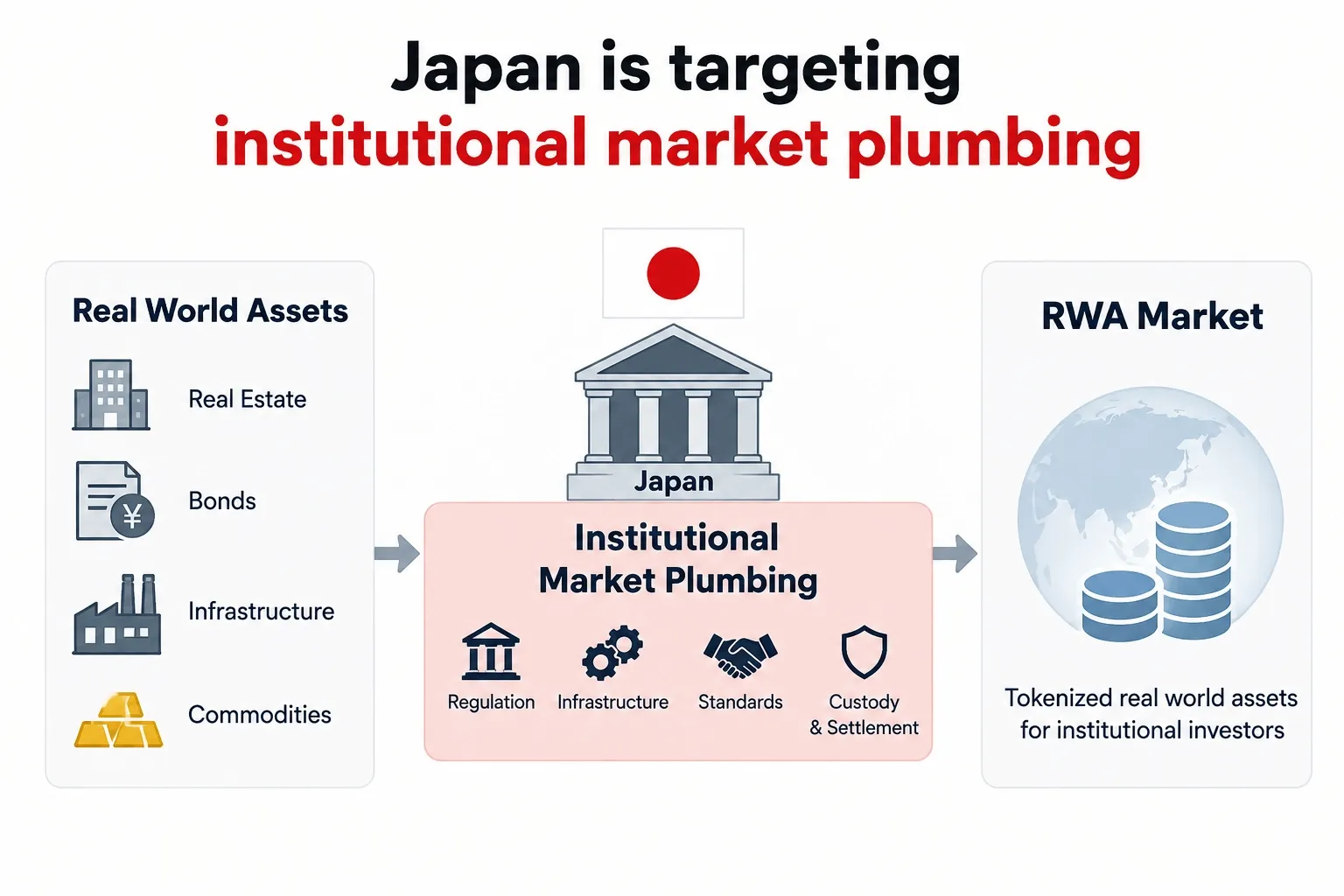
Japan is worth watching because its RWA activity is moving beyond retail tokenization.
Japan enacted amendments to its Financial Instruments and Exchange Act and Payment Services Act on July 15, 2026, as part of a wider update covering crypto-assets, market transparency, investor protection and capital formation.
SBI Holdings and Ondo are separately pursuing the tokenization of Japanese assets including equities, while studying the potential use of SBI's yen-denominated JPYSC stablecoin for settlement and collateral. Those initiatives remain development plans rather than evidence that a large Japanese onchain equity market already exists. (SBI announcement)
More strategically, Progmat has launched work around tokenized Japanese government bonds and onchain repo transactions.
Its working group targets an October 2026 report and has stated a goal of progressing specific tokenized JGB issuance projects within 2026 where appropriate. Progmat launched a proof of concept for onchain JGB repo transactions in August.
Repo is critical financial infrastructure used for short-term funding and collateral management.
If tokenization proves useful there, it would be stronger evidence of genuine financial-market transformation than another fractionalized consumer asset.

Pakistan has an opportunity, but it is still building the market
Pakistan is earlier in the cycle.
PVARA's Pakistan Virtual Asset Services Regulations and Activity Specific Regulations came into force on August 21, 2026. The regulator's application portal now covers regulatory sandbox participation, NOCs and VASP licences. The framework addresses licensing, governance, technology, AML controls, client assets and activity-specific requirements.
Pakistan is also examining sovereign tokenization.
PVARA and the State Bank of Pakistan are studying a digitally native sovereign note that could operate on regulated blockchain infrastructure, settle on the same day and remain interoperable with the conventional financial system. (Government of Pakistan statement)
Finance Minister Muhammad Aurangzeb has also identified sovereign debt, remittances, SME financing and broader financial access as areas where tokenization could address practical economic problems.
This is opportunity rather than scale.
Pakistan does not yet have a significant live sovereign RWA market. The regulatory framework is now operational, while sovereign tokenization remains under study.
For founders and financial institutions, this distinction is critical. The immediate opportunity may be in regulated infrastructure, custody, compliance, asset servicing, wallet technology, settlement, identity and distribution, rather than assuming a large tokenized sovereign market already exists.
The forecasts show how uncertain this market still is
Executive teams should also be skeptical of enormous RWA forecasts.
McKinsey estimated in 2024 that tokenized financial assets could reach roughly $2 trillion by 2030 in its base case, excluding cryptocurrencies and stablecoins, with a range of approximately $1 trillion to $4 trillion.
BCG's 2026 asset-management report is dramatically more aggressive. Its middle scenario estimates $14 trillion of tokenized RWAs by 2030 and $55 trillion by 2035, excluding stablecoins, repos and real estate.
These estimates are not directly comparable because their definitions and methodologies differ.
But the gap between $2 trillion and $14 trillion is itself useful evidence.
No board should build a strategy around the assumption that a specific multitrillion-dollar forecast will happen.
At today's approximately $38.6 billion distributed market size, even McKinsey's lower base case would require extraordinary expansion. BCG's scenario would require a transformation orders of magnitude larger.
The opportunity is significant. The eventual size remains uncertain.
The forecasts show how uncertain this market still is
Executive teams should also be skeptical of enormous RWA forecasts.
McKinsey estimated in 2024 that tokenized financial assets could reach roughly $2 trillion by 2030 in its base case, excluding cryptocurrencies and stablecoins, with a range of approximately $1 trillion to $4 trillion.
BCG's 2026 asset-management report is dramatically more aggressive. Its middle scenario estimates $14 trillion of tokenized RWAs by 2030 and $55 trillion by 2035, excluding stablecoins, repos and real estate.
These estimates are not directly comparable because their definitions and methodologies differ.
But the gap between $2 trillion and $14 trillion is itself useful evidence.
No board should build a strategy around the assumption that a specific multitrillion-dollar forecast will happen.
At today's approximately $38.6 billion distributed market size, even McKinsey's lower base case would require extraordinary expansion. BCG's scenario would require a transformation orders of magnitude larger.
The opportunity is significant. The eventual size remains uncertain.
What boards should be watching now
The most useful RWA metrics over the next 12 to 24 months will not be the number of token announcements.
Boards should watch whether tokenized assets produce measurable improvements in net asset flows, secondary liquidity, bid-ask spreads, settlement time, collateral utilization, redemption speed, operational cost, distribution reach and capital efficiency.
DTCC's October tokenization-service launch will be particularly important because DTC already custodies more than $114 trillion of securities.
The SEC's Innovation Exemption will show whether regulated tokenized-stock venues can attract meaningful liquidity rather than simply proving that they can technically operate.
NYSE's planned tokenized securities platform will test whether always-on blockchain trading can coexist with existing shareholder rights, corporate actions and market surveillance.
Europe's Pontes programme will test whether central-bank-money settlement can help tokenized markets move beyond fragmented private networks.
Japan's JGB work will test tokenization inside sovereign collateral and repo markets. Pakistan will test whether a newly regulated emerging market can use tokenization to improve sovereign financing, remittances and capital-market access.
The opportunity for founders is changing
For entrepreneurs, the easy RWA pitch is becoming less interesting.
"Put an asset on blockchain" is no longer sufficient differentiation.
The more defensible opportunities are likely to exist where financial institutions still have expensive friction:
institutional-grade issuance infrastructure, cross-chain interoperability, asset servicing, digital transfer agency, programmable compliance, custody orchestration, collateral management, private credit infrastructure, tokenized treasury management, settlement connectivity and cross-border distribution.
The strongest businesses may never become household crypto brands.
They may instead become the software and infrastructure providers sitting between asset managers, banks, exchanges, custodians, regulators and blockchain networks.
That is how financial infrastructure markets usually mature.
What can still go wrong
Tokenization does not eliminate financial risk. It can change where that risk sits.
The Financial Stability Board has identified potential vulnerabilities including liquidity and maturity mismatches, leverage, asset-quality and pricing problems, increased interconnectedness and operational fragility. Dependence on custodians, smart contracts, bridges, private keys and external data providers can introduce additional points of failure. (FSB analysis of tokenization risks)
There is also a fundamental liquidity problem.
A token can move every second while its underlying asset remains difficult to sell.
Putting an illiquid private loan, property or fund on a blockchain does not automatically create buyers for it.
Interoperability presents another challenge. The ECB has warned that incompatible DLT platforms could reproduce the fragmentation tokenization is supposed to remove. (BIS speech on Europe's tokenized financial market)
The Bank for International Settlements similarly argues that tokenization's potential depends on linking money and assets while maintaining trusted settlement, sound governance and interoperability with existing financial systems. (BIS Annual Economic Report on the next-generation monetary and financial system)
These constraints are why the market's movement toward regulated infrastructure matters.
What comes next
The first phase of RWA proved that traditional financial assets could be represented on blockchain networks.
The second phase is testing whether those assets can become operationally superior financial instruments.
The emerging architecture is becoming visible:
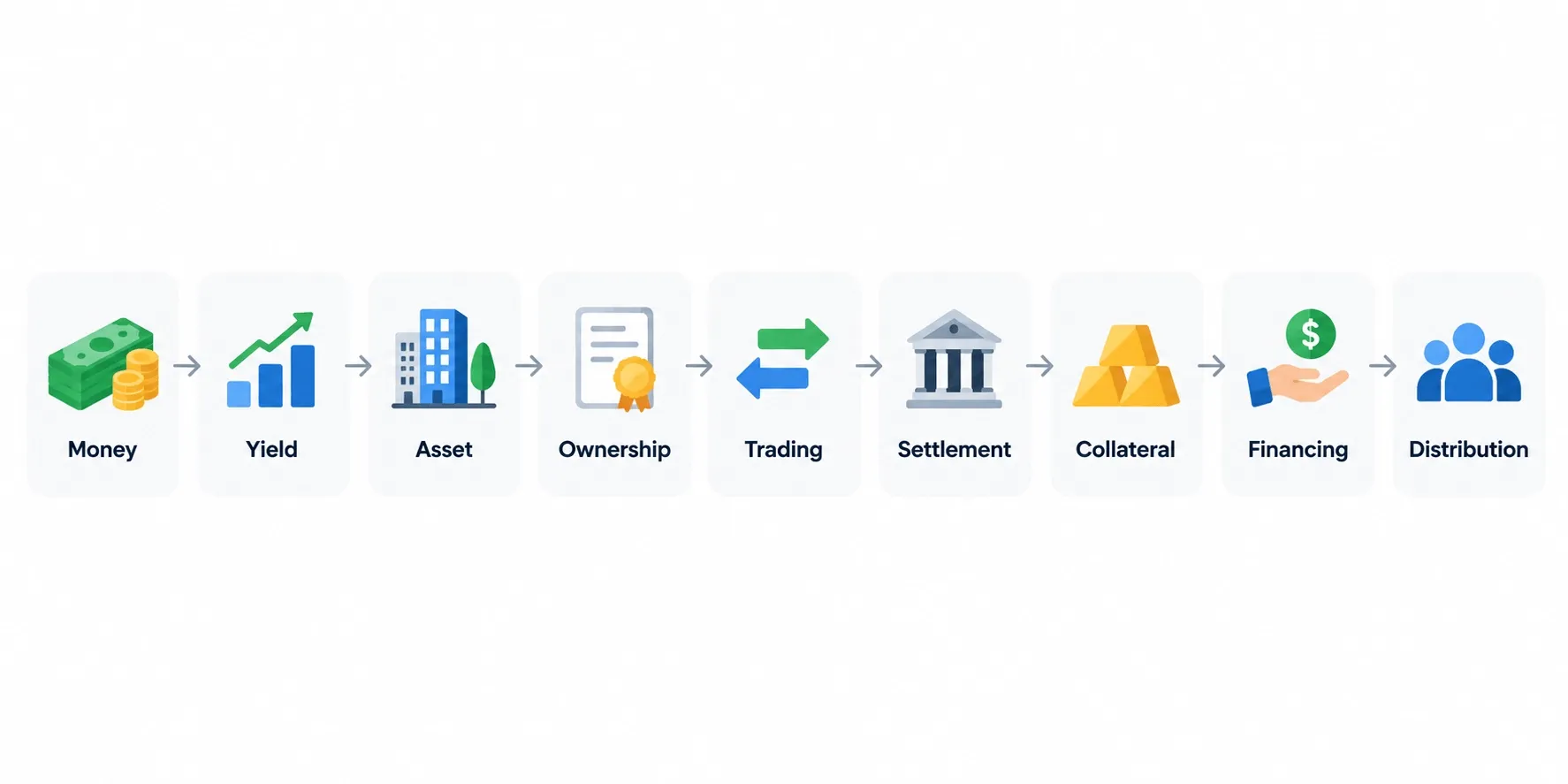
Stablecoins and tokenized deposits can provide money. Tokenized money-market funds can provide yield. Platforms such as Securitize and Ondo provide issuance and distribution. DTCC and transfer agents can connect ownership records with conventional markets. NYSE and emerging tokenized securities venues can provide trading. Pontes and bank infrastructure can address settlement. J.P. Morgan, Franklin Templeton, BlackRock-linked products and others are beginning to make tokenized assets usable as collateral.
The market is starting to connect.
That is the development CXOs and boards should pay attention to.
RWA should no longer be evaluated primarily as a crypto allocation or blockchain experiment. It is becoming a question about how the next generation of capital markets could operate and which parts of today's financial operating model remain necessary once money, securities and collateral become programmable.
The businesses that benefit most may not be those that simply tokenize the largest quantity of assets.
They will be those that reduce an expensive financial friction that already exists.
Sources & References
- Depository Trust & Clearing Corporationdtcc.com
- DTCC plans to launch its DTC Tokenization Service in October 2026dtcc.com
- RWA.xyzrwa.xyz
- U.S. Treasury fundsapp.rwa.xyz
- Tokenized creditapp.rwa.xyz
- Commoditiesapp.rwa.xyz
- Active strategiesapp.rwa.xyz
- Tokenized stocksapp.rwa.xyz
- Private equity and VCapp.rwa.xyz
- Real estateapp.rwa.xyz
- Ondoondo.finance
- Franklin Templeton's Benji platformfranklintempleton.com
- Circlecircle.com
- Securitizesecuritize.io
- RWA.xyz showed approximately $3.88 billion in distributed assetsapp.rwa.xyz
- Stocks product has passed $1 billion in TVL and $26 billion in cumulative trading volumeondo.finance
- Ondo and Alpaca introduced an in-kind mechanismondo.finance
- RWA.xyz platform measureapp.rwa.xyz
- BlackRock's BUIDLsecuritize.io
- BlackRock, Securitize, OKX and Standard Charteredinvestors.securitize.io
- ARK Invest announced on September 24 that its ARK Venture Fund would be tokenized using Securitizeinvestors.securitize.io
- NYSEnyse.com
- NYSE and Securitize agreed in March to develop infrastructure around an upcoming NYSE-affiliated digital trading platforminvestors.securitize.io
- NYSE discussion of its tokenized securities platformtv.nyse.com
- BENJI suite had $1.98 billion in assets under management by April 29franklintempleton.com
- use Benji-issued tokenized money-market fund shares as off-exchange collateral when trading on Binancefranklintempleton.com
- J.P. Morganjpmorgan.com
- Kinexys infrastructurejpmorgan.com
- Kinexys had processed more than $4 trillion in transactions since inception and was averaging approximately $7 billion per dayjpmorgan.com
- Tokenized Collateral Networkjpmorgan.com
- State Streetstatestreet.com
- SWEEP fund, developed with Galaxyinvestors.statestreet.com
- Swift announced in July that its blockchain ledger was ready for initial useswift.com
- Ethereumethereum.org
- RWA.xyz's dataapp.rwa.xyz
- Solanasolana.com
- RWA.xyz's Solana network dataapp.rwa.xyz
- The Senate failed to advance the CLARITY Act on September 15reuters.com
- SEC issued a temporary conditional Innovation Exemptionsec.gov
- Eurosystem launched Pontes on September 21ecb.europa.eu
- European Central Bankecb.europa.eu
- amendments to its Financial Instruments and Exchange Act and Payment Services Act on July 15, 2026fsa.go.jp
- SBI Holdingssbigroup.co.jp
- SBI announcementsbigroup.co.jp
- Progmatprogmat.co.jp
- working group targets an October 2026 reportprogmat.co.jp
- PVARA's Pakistan Virtual Asset Services Regulations and Activity Specific Regulationspvara.gov.pk
- PVARApvara.gov.pk
- State Bank of Pakistansbp.org.pk
- Government of Pakistan statementpid.gov.pk
- sovereign debt, remittances, SME financing and broader financial accesspid.gov.pk
- McKinsey estimated in 2024mckinsey.com
- BCG's 2026 asset-management reportbcg.com
- Financial Stability Boardfsb.org
- FSB analysis of tokenization risksfsb.org
- BIS speech on Europe's tokenized financial marketbis.org
- Bank for International Settlementsbis.org
- BIS Annual Economic Report on the next-generation monetary and financial systembis.org
- Pontesecb.europa.eu