

The AI Investment Boom Is Growing but Wall Street Wants to Know Who Will Profit
Artificial intelligence attracted extraordinary investment between September and October 2026, as major technology companies expanded computing infrastructure and introduced more capable AI models. But a $1.64 trillion semiconductor selloff, rising borrowing costs and slowing revenue growth at some AI leaders exposed a widening gap between technological progress and financial returns. The next phase of AI competition will test whether Meta, Anthropic, Nvidia, Google and OpenAI can turn expanding capabilities into sustainable profits.
The Signal — Key Takeaways
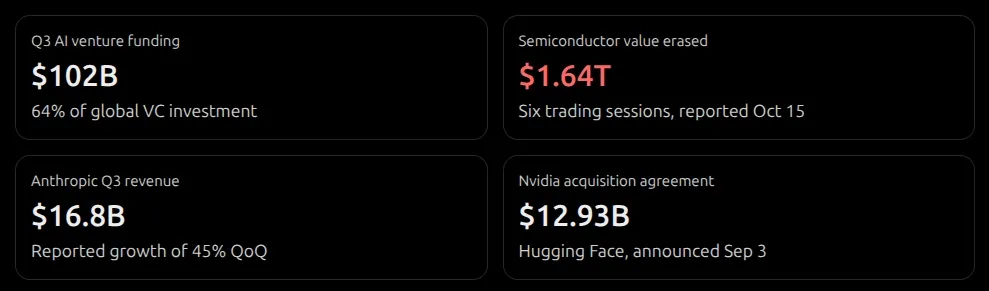
- 01AI investment remains concentrated: Startups working across the AI ecosystem attracted 64% of global venture funding in Q3 2026.
- 02Agentic AI is becoming the competitive focus: OpenAI, Google, Anthropic and Meta increasingly compete on task execution, distribution and operating costs.
- 03AI infrastructure faces greater financial scrutiny: October's market correction and IMF findings expose the risks associated with borrowing and interconnected revenue commitments.
- 04MANGO companies are not financially interchangeable: Nvidia, Alphabet and Meta have established public financial records, while OpenAI and Anthropic have different funding dependencies and disclosure limitations.
- 05The next stage depends on returns: Sustained utilisation, inference economics, margins and cash flow will matter more as investors assess whether AI investment can produce durable profits.
The AI boom is expanding, but the financial equation is changing
The artificial intelligence industry entered September 2026 with capital continuing to flow into frontier models, semiconductor manufacturing, cloud infrastructure and automation platforms. By October 20, the investment cycle had reached a more demanding phase. Investors were no longer evaluating AI companies on technological capabilities and growth prospects alone. They were questioning the cost of delivering those capabilities, the financial structures supporting infrastructure expansion and the profits required to justify enormous valuations.
According to Crunchbase's October 5 venture capital report, AI startups captured $102 billion of the $159 billion invested globally during the third quarter. Twenty-seven companies raised rounds of at least $1 billion, setting a quarterly record. Although these numbers cover July through September rather than the entire seven-week reporting window, they establish the investment environment entering October.
Yet the October market correction revealed how quickly enthusiasm can turn into financial scrutiny. Reuters reported that $1.64 trillion had been erased from US semiconductor market values over six trading sessions as inflation, borrowing costs and concerns about AI infrastructure spending unsettled investors. The loss was a decline in stock-market valuations, not $1.64 trillion in corporate cash disappearing. TDisrupt previously examined the consequences in The $1.6 Trillion AI Selloff Is Exposing Who Can Actually Pay for the Boom.
At the centre of this transition are five influential AI companies: Meta, Anthropic, Nvidia, Google (Alphabet) and OpenAI, informally grouped as MANGO. Their business models differ substantially. Nvidia sells the computing infrastructure, Google and Meta combine AI development with established revenue-generating businesses, while Anthropic and OpenAI depend more directly on converting model capabilities and AI services into commercial revenue.
The central question is no longer simply which company can build the most capable AI. It is which can develop, distribute and operate AI economically enough to earn durable returns.
Investment keeps accelerating, but the capital is increasingly concentrated
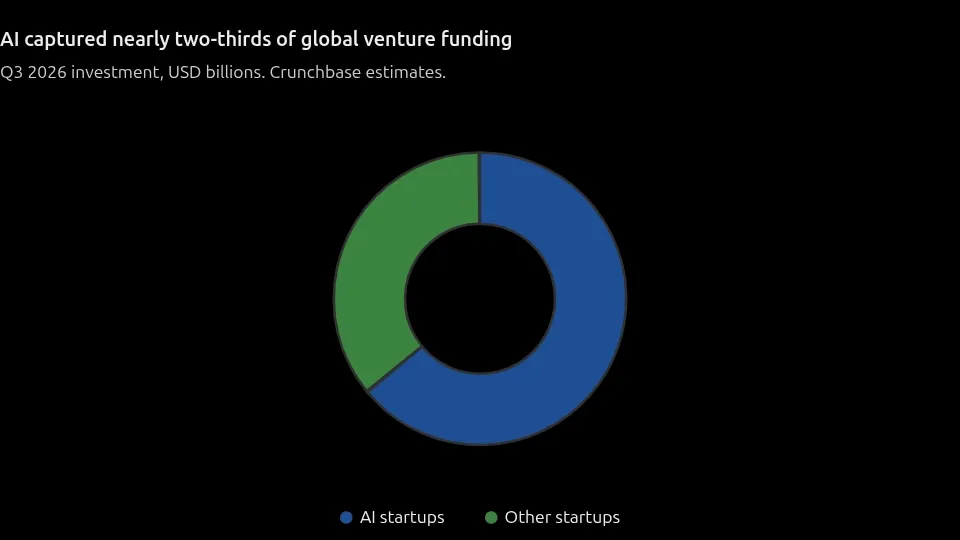
Source: Crunchbase, Q3 2026 global venture funding. The figures cover the entire third quarter, including July and August.
This concentration creates two contrasting investment environments. Leading AI labs, infrastructure platforms and semiconductor companies can attract financing on a scale that few ordinary startups can match. Smaller technology businesses increasingly face competitors backed by enormous capital commitments, while investors must accept greater portfolio concentration.
Capital expenditure by the largest cloud operators demonstrates the scale of the infrastructure cycle. Amazon, Alphabet, Microsoft and Meta entered the reporting period with annual spending plans collectively exceeding $700 billion.
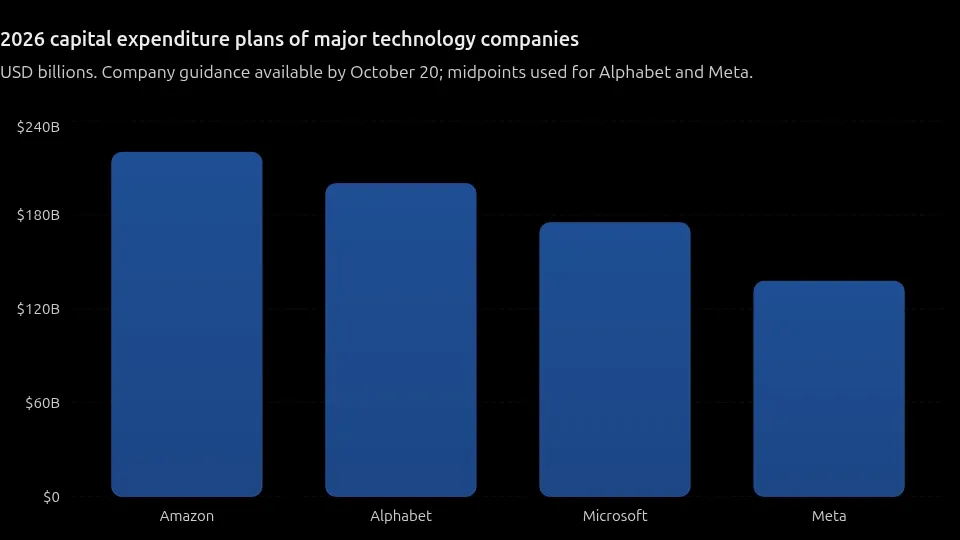
Sources: Amazon, Alphabet, Microsoft, and Meta. These are company-wide spending plans, not exclusively AI investment. Microsoft revised its reported capex expectation to approximately $175 billion following a change in lease classification, which affects comparability.
For technology companies, the financial challenge is that investment precedes monetization. Data centres require land, power, cooling equipment, semiconductors and network connectivity before generating revenue. AI accelerators also have shorter economic lives than many physical infrastructure assets because successive chip generations can deliver better performance per dollar.
Amazon offers a clear example. Its second-quarter financial results, published before September, showed AWS revenue increasing 37% to $42.2 billion. Yet Amazon reported negative free cash flow of $7.6 billion over the trailing twelve months, driven mainly by infrastructure investment. Strong operating demand and negative free cash flow can therefore exist simultaneously.
Major investments and financial commitments announced during the period
Date | Company or project | Value | Status and significance |
|---|---|---|---|
Sep 3 | $12.93B | Acquisition agreement. Expands Nvidia's position in AI model and developer distribution | |
Sep 28 | +$150B | Additional authorization, not money already spent or AI capex | |
Sep 29 | $88M | Announced Series A funding for optical AI memory architecture | |
Oct 2 | $100M | Company commitment to train 10,000 enterprise AI engineers | |
Oct 19 | ~$45B | Reported computing agreement under discussion, not finalized | |
Oct 19 | $30B | Reported proposed funding round, not completed |
Sources: Company disclosures and Reuters reports dated September 3 through October 19, 2026. The values represent different financial activities and should not be combined as a total investment figure
Nvidia's proposed acquisition of Hugging Face is particularly consequential. It extends the chipmaker's commercial reach into a platform used to distribute, evaluate and deploy AI models. The strategic value goes beyond the purchase price: developer relationships and software infrastructure can reinforce demand for Nvidia computing systems even as customers experiment with competing accelerators.
For emerging semiconductor businesses, investment is also moving toward problems that additional GPU capacity alone cannot solve. TDisrupt's analysis of Volantis and optical AI memory examined the company's effort to move data between processors and memory using photonics. Its proposed performance benefits remain dependent on successful engineering, manufacturing and commercial deployment.
AI technology competition moves toward execution and lower costs
September and October produced another round of frontier-model improvements, but the technological direction matters more than the product launches individually.
OpenAI introduced its GPT-6 family, Anthropic expanded Claude 5.5, Google launched Gemini 4 Argon and Meta introduced Muse. These systems increasingly target sustained software engineering, computer use, enterprise workflows and autonomous task execution, rather than conversational responses alone.
Company | Development | Potential commercial impact |
|---|---|---|
OpenAI | Expands the range from advanced reasoning to lower-cost, high-volume tasks | |
Anthropic | Stronger agentic coding and lower operating costs | |
Direct competition in enterprise reasoning, coding and agent workflows | ||
Meta | Potential new interface for consumer tasks, commerce and connected applications | |
OpenAI | Persistent agents that can continue work between conversations | |
TypeSafe AI | Specialized structured decisions could reduce dependence on expensive general-purpose models |
These developments point toward two related shifts.
The first is competition to own the software execution layer. OpenAI Dots and Meta Muse represent competing approaches to agents that remember context, operate tools and complete work across applications. Google is making a similar push into professional work through Gemini 4 Argon.
The commercial opportunity extends beyond subscriptions to individual AI assistants. If agents become reliable interfaces for completing tasks, they could affect how software vendors price products, how enterprises allocate software budgets and which platforms control access to business workflows.
These possibilities are not yet proven financial outcomes. Long-running autonomous systems still face reliability, security, authorization and oversight constraints. Greater model capability does not automatically mean organisations can safely remove human review from consequential workflows.
The second shift is toward cheaper inference, the computation needed to run an AI model after training.
OpenAI's published pricing puts GPT-6 Sol at $2 per million input tokens and $10 per million output tokens, with Luna at $0.10 and $0.50 respectively. Anthropic says Claude Haiku 5.5 costs approximately 75% less to operate than its predecessor on average. These are provider claims and pricing schedules, not independent measurements of equivalent performance.
Lower inference prices can unlock workflows that were previously too expensive to automate. But they also create commercial pressure for model providers to increase usage faster than prices fall.
TDisrupt explored a related approach in Jev Could Change the Economics of Enterprise AI Agents. The underlying question is whether specialised models can handle repetitive decisions more efficiently, reserving expensive frontier models for tasks requiring deeper reasoning.
The result could be a more economically efficient AI market, without guaranteeing higher profits for every company supplying the intelligence.
Financial performance: MANGO companies face different pressures
The financial position of the five AI leaders is considerably less uniform than their technological ambitions suggest.
Meta and Alphabet earn substantial revenue from advertising and other established products. Nvidia already generates large-scale revenue from AI infrastructure sales. Anthropic and OpenAI have reported rapid growth in AI services, but their financial disclosures are less comprehensive than those of public companies.
Company | Latest relevant evidence available by Oct 20 | Financial interpretation |
|---|---|---|
Meta | Q2 revenue of $60.8B; 2026 capex guidance of $130B–$145B | Established advertising revenue supports investment, but AI infrastructure adds substantial cost |
Anthropic | Reported Q3 revenue of $16.8B, up 45% QoQ | Rapid growth, but materially slower than the previous quarter |
Nvidia | Fiscal Q2 2027 revenue of $96.2B, including $89B from data centres | Strong demonstrated hardware monetization, with exposure to customer infrastructure budgets |
Alphabet | Q2 Google Cloud revenue of $24.8B, up 82% YoY | Cloud expansion provides substantial revenue evidence alongside rising investment |
OpenAI | Reported ~$50B annualized revenue; proposed $30B fundraising | Strong reported commercial scale, with profitability and future capital needs less transparent |
Sources: Meta earnings, Anthropic investor-report coverage, Nvidia financial results, Alphabet SEC filing, and OpenAI financing report. Reporting periods and accounting measures differ.
Anthropic's revenue illustrates the tension between growth and expectations
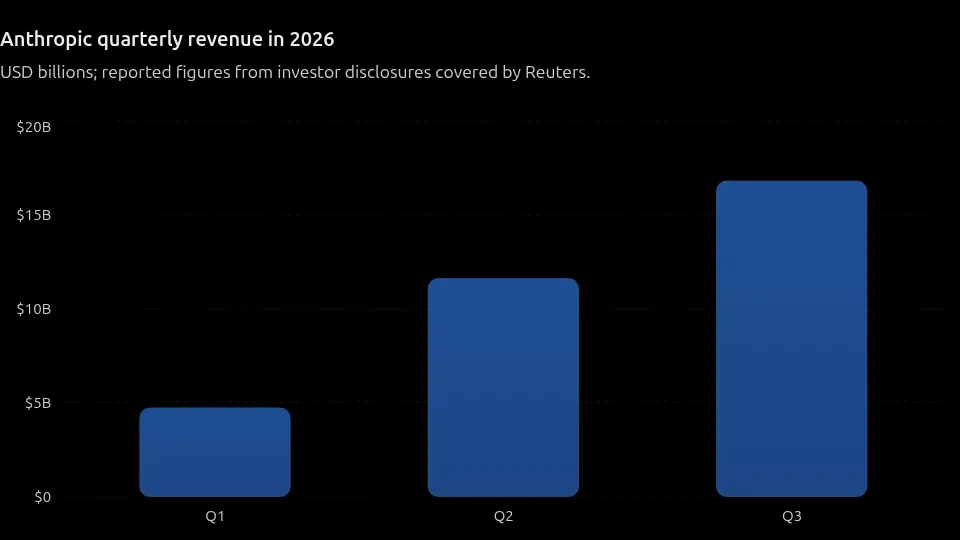
Source: Reuters, October 14, 2026. Anthropic is privately held; the figures were reported from company disclosures to prospective investors.
Reuters
Anthropic's revenue increased substantially in absolute terms, but quarterly growth slowed from approximately 147% in the second quarter to 45% in the third. That distinction matters because a business can continue growing rapidly while failing to meet expectations embedded in its valuation.
Reuters' October 15 financial analysis also highlighted declining revenue per token despite strong consumption growth. The company reportedly achieved an 11% adjusted operating margin for the first nine months of 2026. That is not equivalent to an audited full-year net profit, particularly because adjusted measures can exclude material expenses.
OpenAI faces a related question. Reuters reported on October 19 that the company was accelerating a proposed $30 billion capital raise that could value it above $1.4 trillion. Such a valuation would depend on investors expecting substantial future growth, not simply the revenue already achieved. The fundraising had not been finalized as of the reporting date.
For Meta and Alphabet, the pressure is different. Their existing businesses generate large revenues, but investors must still assess whether incremental AI investments create more value than their cost of capital. Meta's AI investments could strengthen advertising, business messaging and future agent services, while Alphabet may benefit from demand for Google Cloud, Gemini and its TPU infrastructure. Neither outcome means every dollar of capex will earn an attractive return.
Nvidia occupies another position in the market. Its reported $89 billion quarterly data-centre revenue provides direct evidence of AI infrastructure demand. But its sales depend partly on the ability of cloud providers, AI labs and specialised infrastructure companies to continue financing orders.
Debt, circular financing and the risk of an AI investment correction
The strongest evidence of systemic financial risk came from the International Monetary Fund's October 2026 Global Financial Stability Report.
The IMF examined 14 publicly disclosed AI-related transactions dating back to 2023. It identified approximately $300 billion in equity investments, $650 billion in supporting debt and $1.4 trillion in future revenue commitments. Around $320 billion of the debt was associated with companies receiving investments, including financing backed by guarantees or other contingent structures.
IMF findings: Interconnected AI financing arrangements
Financial exposure | Amount |
Equity investment | $300B |
Supporting debt | $650B |
Future revenue commitments | $1.4T |
Fourteen disclosed transactions since 2023. These are different financial exposures, not components of a single cumulative investment total.
The risk arises when an investor finances a company that then agrees to purchase the investor's computing services or equipment. Such arrangements may support real commercial demand, but they also create interdependence. If the recipient cannot earn enough revenue, both the investment and the expected customer payments could come under pressure.
Concern has begun appearing in credit markets. The Financial Times reported that trading in credit default swaps, which investors use to hedge debt-default risk, had increased substantially for AI-exposed companies. Meanwhile, S&P Global warned through Reuters that interconnected financing structures may obscure the full extent of some hyperscalers' AI-related liabilities.
CoreWeave has become a particularly visible test of this financing model as its shares and debt instruments experienced severe volatility. But its difficulties should not be generalized to every infrastructure provider. J.P. Morgan's October 20 assessment suggested that direct risks to major international banks remained relatively contained.
The evidence therefore supports a distinction: financing stress is real, but an industry-wide collapse is not established.
What the developments mean for the wider technology market
The investment cycle is creating opportunities beyond the leading AI laboratories.
Semiconductor designers, high-bandwidth memory producers, networking companies, power infrastructure suppliers and advanced cooling businesses can benefit from ongoing data-centre expansion. Enterprise software companies may gain from integrating agents into established workflows, provided they can demonstrate customer value and reliable execution.
At the same time, lower inference prices could redistribute economic value away from model providers and toward businesses building applications. More affordable models reduce the cost of experimentation, but stronger general-purpose assistants may also compete directly with independent software products.
This leaves the technology industry with three major commercial questions: whether compute spending will translate into sustained utilisation, whether falling AI prices will stimulate enough additional demand to support margins, and whether autonomous agents will create genuinely new revenue rather than simply absorb existing software budgets.
The answers will differ by company. Nvidia's infrastructure economics, Meta's consumer distribution, Google's cloud business, Anthropic's enterprise focus and OpenAI's product ecosystem create different paths to monetization and different financial vulnerabilities.
Outlook: What investors and technology leaders should watch next
The next earnings cycle will be a test of whether infrastructure commitments are supported by stronger commercial results. Meta's upcoming third-quarter results will draw attention to Muse adoption, advertising performance and capital spending. Google's financial results will provide another indication of cloud demand and infrastructure monetization. Nvidia's future disclosures will show whether hardware orders remain resilient through the market correction.
For private AI companies, stronger revenue growth alone may no longer satisfy investors. Profitability, cash conversion, inference margins, financing arrangements and the reliability of revenue forecasts are becoming more important measures of business quality.
The central conclusion is not that AI adoption is ending or that infrastructure investment has become unnecessary. Rather, AI technology is becoming more capable and less expensive at the same time that the financial cost of building and operating it remains exceptionally high.
That divergence may determine which companies retain pricing power, which infrastructure businesses can finance expansion and which investors ultimately capture the value AI creates.
The industry has demonstrated its willingness to spend. Its next challenge is proving that the spending earns sufficient returns.
Research methodology: Information is limited to developments known by October 20, 2026. Earlier financial statements are used as baselines where newer reports had not been published. Proposed investments, reported valuations, company forecasts and adjusted financial metrics are distinguished from completed transactions and audited financial results. All dollar amounts are US dollars unless otherwise stated.
Sources & References
- Crunchbase's October 5 venture capital reportnews.crunchbase.com
- Reuters reportedreuters.com
- The $1.6 Trillion AI Selloff Is Exposing Who Can Actually Pay for the Boomtdisrupt.com
- Amazonreuters.com
- Alphabetreuters.com
- Microsoftmicrosoft.com
- Metainvestor.atmeta.com
- second-quarter financial resultsaboutamazon.com
- Nvidia and Hugging Faceblogs.nvidia.com
- Nvidia share repurchasesinvestor.nvidia.com
- Volantis photonicstdisrupt.com
- Anthropic Frontier Academyanthropic.com
- Anthropic and Nscalereuters.com
- OpenAI financingreuters.com
- GPT-6 Astraopenai.com
- Sol and Lunaopenai.com
- Claude Opus, Sonnet and Haiku 5.5anthropic.com
- Gemini 4 Argondocs.cloud.google.com
- Muse personal AI agentabout.fb.com
- Dotsopenai.com
- Jev System One modeltypesafe.ai
- OpenAI Dotstdisrupt.com
- Meta Musetdisrupt.com
- Gemini 4 Argontdisrupt.com
- Claude Haiku 5.5anthropic.com
- Jev Could Change the Economics of Enterprise AI Agentstdisrupt.com
- Anthropic investor-report coveragereuters.com
- Nvidia financial resultsinvestor.nvidia.com
- Alphabet SEC filingsec.gov
- October 15 financial analysisreuters.com
- International Monetary Fund's October 2026 Global Financial Stability Reportelibrary.imf.org
- Financial Times reportedft.com
- S&P Global warned through Reutersreuters.com
- J.P. Morgan's October 20 assessmentreuters.com