

Binance’s $6.3 Billion Hack Puts Crypto’s Trust and Liquidity on Trial
Binance has suffered an estimated $6.3 billion cryptocurrency theft, potentially the largest crypto heist in history. With approximately $3 billion in stolen assets frozen, $6.34 billion in company resources allocated to cover losses, and withdrawals suspended, the breach is testing the world's largest cryptocurrency exchange and confidence in centralized digital asset custody. Market analysts warn of liquidity pressure and further volatility, while blockchain investigators have linked the operation to North Korea-associated hackers.

Key Takeaways
- 01Binance reported an estimated $6.3 billion security incident, while TRM Labs independently traced approximately $6.36 billion across ten blockchain networks.
- 02The exchange says around $3 billion in stolen assets has been frozen and more than $6.34 billion in corporate resources allocated to cover customer losses.
- 03Blockchain investigators have linked the attack to North Korea-associated TraderTraitor operators, although Binance has not published its final root-cause investigation.
- 04Market analysts are concerned about liquidity pressure, institutional confidence and possible capital migration toward alternative exchanges and custodians.
- 05The incident may accelerate investment in transaction authorization controls, privileged-access protection and real-time cross-chain monitoring.
- 06Withdrawal reopening, updated reserves and Binance's technical post-mortem will be the strongest evidence of operational recovery.
A $6.3 Billion Theft, but the Bigger Test Is Still Ahead
The world's largest cryptocurrency exchange is facing a security crisis that could reshape how investors, regulators and technology companies assess digital asset custody. On October 29, attackers moved approximately $6.3 billion in cryptocurrency from Binance-controlled wallets across multiple blockchain networks. Within hours, Bitcoin and Ether fell, leveraged trading positions were liquidated, and Binance suspended withdrawals while investigating the incident.
The theft is extraordinary, but the more consequential question is what happens next. Binance must demonstrate that customers can regain access to their assets, that its transaction-signing infrastructure is secure, and that a multibillion-dollar loss will not undermine the exchange's financial stability.
According to Binance's official security announcement, the initial investigation pointed to a compromised DevOps engineer's laptop that may have allowed attackers to access a service container and initiate unauthorized withdrawal transactions. The company said it had found no evidence that wallet private keys were leaked. However, investigators subsequently identified additional breach points, suggesting a more complicated attack than a single compromised device
The distinction matters. If attackers manipulated systems authorized to approve legitimate transfers, protecting private keys alone was not sufficient. The failure extended into the infrastructure responsible for deciding when, where and how customer assets could move.
Independent blockchain investigators, including TRM Labs, have attributed the attack to North Korea-associated TraderTraitor operators with high confidence. Binance has not publicly confirmed the perpetrators, and its final technical investigation remains outstanding.
The incident has also created an unusual contest between attackers trying to move stolen assets beyond recovery and stablecoin issuers capable of freezing billions of dollars on-chain. But frozen assets are not the same as recovered assets, and promises of compensation are not yet independent proof that all customer liabilities have been fully covered.
The outcome will depend on three questions: how much can actually be recovered, whether Binance can fulfill its compensation commitments, and how customers and institutions respond when withdrawals reopen.
$6.3B | $3.0B | $6.34B |
|---|---|---|
Estimated attack impact | Binance-reported freezes | Company funds allocated |
October 30 disclosures. Binance says its corporate compensation provision is separate from the frozen stolen assets.
How the Attack Spread Across Blockchain Networks
The theft was not a single unauthorized transfer. It was a coordinated movement of assets across multiple blockchain networks, with investigators identifying preparations at least 36 hours before the main attack.
According to TRM Labs' forensic reconstruction, attackers used test transactions, smart-contract deployments and prearranged authorizations before moving most of the stolen value in roughly 20 minutes. Bitquery's independent investigation traced approximately $6.3 billion leaving 17 Binance hot wallets across nine networks over a period of nearly four hours. TRM identified ten affected networks, reflecting differences in investigative classification.
Mapping the stolen assets across blockchain networks
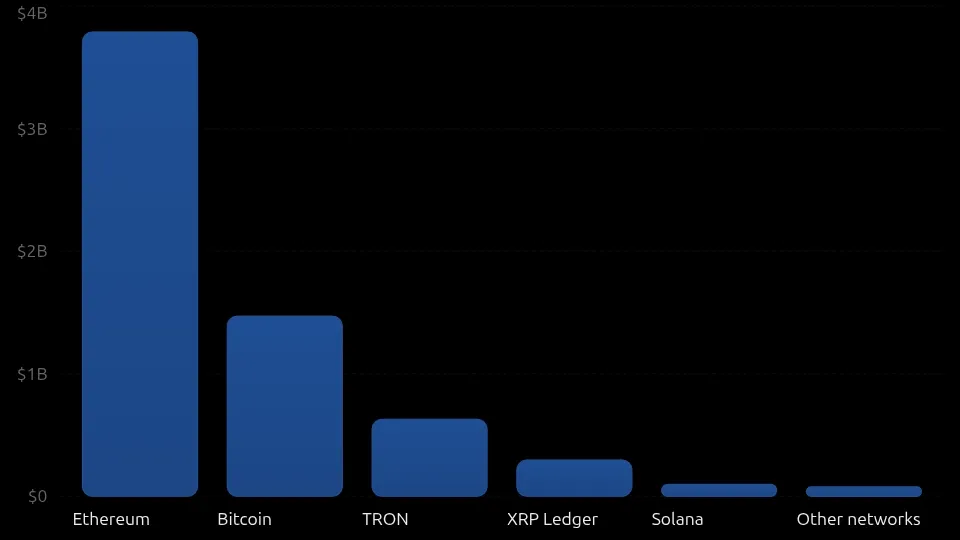
Approximate USD billions at theft-time prices. Other networks include Arbitrum, Optimism, Base, Avalanche and Polygon. Source: TRM Labs' October 30 investigation.
Ethereum accounted for approximately $3.79 billion of stolen assets, including 200,630 ETH, 1.875 billion USDT and 823 million USDC. Bitcoin losses totaled 18,270 BTC, worth approximately $1.47 billion. Substantial transfers also occurred through TRON, XRP Ledger and Solana.
The most revealing evidence concerns Binance's Ethereum hot wallet, known as Binance 14. Investigators discovered that attackers used 50 pre-signed EIP-7702 authorizations to make the wallet execute malicious smart-contract code.
EIP-7702 is an Ethereum feature that allows ordinary accounts to delegate execution to smart contracts. According to Beosin's technical analysis, the attacker exploited that functionality to make an authorized Binance wallet execute a contract designed to transfer assets into attacker-controlled addresses.
The initial sweep removed approximately 167,464 ETH and more than 60 token types. The malicious authorization remained active, enabling further transfers as additional funds entered the wallet.
This was not evidence that Ethereum's underlying blockchain had been compromised. It pointed toward a breach of the infrastructure responsible for controlling valid transactions.
On-chain evidence: hot wallets and attacker transactions
Evidence | Verified blockchain record | Significance |
|---|---|---|
Binance 14 hot wallet | Principal Ethereum wallet targeted through EIP-7702 | |
Binance 16 hot wallet | Secondary affected wallet | |
Attacker receiving address | Received stolen assets and subsequently frozen tokens | |
Binance Bitcoin hot wallet | Source of approximately 18,270 BTC | |
Malicious delegation | Authorization transaction involving 50 signatures | |
Main Ethereum drain | Principal transfer of ETH and other tokens |
Wallet classifications and transaction identifiers from Bitquery and Beosin. Blockchain records establish the transfers; the attribution of addresses to the attacker follows independent forensic analysis.
The apparent ability to initiate valid transfers across different networks is a particularly serious finding. These blockchains use different signing systems, yet unauthorized transfers occurred within the same attack window.
TRM Labs considers the compromise of Binance's transaction-signing infrastructure a likely explanation. Binance's final root-cause investigation has not yet confirmed that assessment.
Nearly Half the Stolen Assets Were Frozen. But Recovery Is a Different Problem
Binance says approximately $3 billion in stolen assets has been frozen. Independent forensic estimates differ slightly depending on the observation period and which assets are classified as frozen or otherwise secured.
TRM Labs identified approximately $2.7 billion in assets immobilized through interventions by token issuers and Arbitrum's Security Council. Those measures involved Tether, Circle, Ripple, World Liberty Financial and other participants.
Tether and Circle accounted for most of the frozen value. Their ability to restrict transfers involving centrally issued stablecoins gave investigators an important way to interrupt the attacker's movement of funds.
Yet the attackers were also converting stablecoins into other cryptocurrencies. Bitquery estimated that approximately $729 million in stolen USDT was exchanged for ETH and TRX before relevant freezes took effect.
A further Bitquery investigation into the trading activity found that the attackers lost approximately $119 million relative to prevailing market prices while urgently exchanging stolen tokens. Trading firms and arbitrage bots captured an estimated $60 million after costs, while nearly $30 million was paid to Ethereum block builders and validators. These are Bitquery's analytical estimates, not confirmed criminal proceeds recovered by Binance.
The finding adds an unusual economic dimension to the case. Even a highly sophisticated attacker moving billions of dollars can lose substantial value when attempting to trade large positions quickly in fragmented markets.
Bitcoin and native Ether present a different recovery challenge. Unlike centrally issued stablecoins, they cannot be frozen by an issuer. Investigators can trace their movement, but obtaining control generally requires cooperation, interception or legal enforcement.
The reported $3 billion frozen therefore represents a significant containment achievement, not necessarily $3 billion already returned to Binance.
Binance Leadership Says Customers Will Be Compensated
Richard Teng | Binance Co-CEO
Teng has told customers that Binance will cover the losses and that the breach involved a complex sequence of events rather than a single employee mistake. The company has promised a complete technical post-mortem and updated Proof of Reserves when remediation is completed.
Yi He | Binance Co-Founder and Co-CEO
Yi He has pledged that customers will not bear the financial damage. In comments reported by Reuters, she said Binance's annual revenue was sufficient to absorb the losses and that it did not need to sell its SpaceX holdings.
Revenue, however, is not the same as profit or immediately available liquidity. Her statement reflects management's confidence, not an independent solvency assessment.
Changpeng Zhao (CZ) | Binance Founder and Former CEO
CZ has expressed confidence that affected customers will be compensated and acknowledged the importance of stablecoin issuers in freezing stolen funds. He also disclosed that Binance held more than $1 billion in SpaceX shares while emphasizing that he no longer directly manages the exchange.
Binance has set aside $6.34 billion. What does that prove?
The most important financial development came when Binance announced that it had allocated more than $6.34 billion of company resources to cover customer losses.
According to Binance's official compensation update, approximately $5 billion was already held in the affected token types. Binance said it was acquiring the remaining $1.34 billion through market and over-the-counter transactions to restore the original asset composition of customer balances.
Binance News on Binance Square
This allocation is separate from the approximately $3 billion in frozen stolen assets. The two figures should not be added together as though both represent completed recovery.
The announcement substantially improves the potential compensation outlook. Nevertheless, an internally reported financial provision is not equivalent to an independent audit. Binance still needs to demonstrate that the assets have been restored, that customer liabilities remain fully backed, and that withdrawals can be honored.
What about Binance's SAFU emergency fund?
Binance's Secure Asset Fund for Users, known as SAFU, is a designated emergency reserve intended to help protect customers following certain security incidents.
The fund has historically been maintained at approximately $1 billion. That is considerably smaller than the estimated losses from this attack, making Binance's corporate resources essential to its compensation strategy.
Binance publicly identifies its Bitcoin SAFU reserve in its official fund documentation.
Official Binance SAFU Bitcoin Address
Inspect the wallet's public Bitcoin transactions. A published wallet address allows public verification of associated transactions, but does not independently establish the exchange's total assets, liabilities or available corporate liquidity. |
|---|
The next significant financial evidence will come from Binance's Proof of Reserves. CoinDesk's analysis of the exchange's earlier reserve disclosures found that affected wallets had been included among assets backing customer balances.
Replacing those assets is therefore essential to restoring confidence in the exchange's reported reserve backing.
The Market Reaction: Liquidations, Wider Spreads and Falling Confidence
The initial market impact was substantial.
Bitcoin briefly fell to approximately $76,400, while Ether declined toward $2,170. BNB also came under selling pressure. According to CoinDesk's October 30 market report, cryptocurrency futures liquidations reached approximately $1.57 billion over 24 hours.
$76,400 | $2,170 | $1.57B |
|---|---|---|
Bitcoin intraday low | Ether intraday low | Reported futures liquidations |
Reported October 30 observations, not live prices. Source: CoinDesk and CoinGlass.
The consequences extended into publicly traded crypto businesses. Reuters reported that Coinbase shares fell approximately 4.8% and Strategy declined nearly 6% in extended trading.
These movements indicate wider investor concern, although the Binance incident was not the only source of market pressure. U.S. technology stocks were also affected by earnings and concerns over AI infrastructure spending.
The more serious issue for the cryptocurrency market is liquidity.
When a major exchange restricts withdrawals, market makers may be unable to transfer capital to other trading venues. Traders can consequently face margin shortages or forced liquidations even when assets are technically available in their exchange accounts.
That means an exchange-level security failure can disrupt the broader market without compromising any underlying blockchain.
What Market Experts Are Saying
Analysts broadly agree that the breach is significant, but they differ on whether it will produce prolonged market damage.
Geoffrey Kendrick, Standard Chartered
Kendrick expects further short-term pressure on cryptocurrency prices until the market receives greater clarity about asset recovery and the circumstances of the attack. His position suggests that financial compensation alone may not immediately eliminate uncertainty.
Tim Sun, HashKey Group
Sun's main concern is the potential liquidity impact. Because Binance is a major global trading venue, restrictions on deposits and withdrawals can make it harder for market makers to move capital between exchanges.
Aravind Srinivasan, GSR
Srinivasan reported that Binance's Bitcoin bid-ask spread widened to approximately five times its normal level during the disruption. Ether spreads widened to approximately 2.5 times normal before narrowing somewhat.
That is direct evidence of deteriorating market liquidity. Wider spreads increase the cost of executing trades, particularly for institutions handling large positions.
Amanda He, ChainUp Investment
He said her firm reduced Binance exposure during the crisis, selling positions that could not be withdrawn and moving accessible assets into more defensive holdings. Her experience illustrates how even institutional clients with diversified portfolios may reduce their exposure during custody uncertainty.
Yuya Hasegawa, Bitbank
Hasegawa offered a more conditional outlook. He believes the market effects could be relatively short-lived if Binance replaces customer assets, restores normal operations and demonstrates that customer balances remain secure. He also emphasized that the Bitcoin network itself was not compromised.
Damon Xu, 1Token
Xu expects cross-exchange trading strategies and leverage to decline while funds remain restricted. His analysis points to an important secondary risk: traders may hold profitable positions on one platform but be unable to access the capital needed to support positions elsewhere.
These views appear in Reuters' interviews with market analysts and institutional investors.
Together, they reveal the central disagreement. The financial loss may be manageable if Binance can replace customer assets. But the impact on liquidity, trading behavior and confidence could continue after compensation begins.
What Happens When Binance Resumes Withdrawals?
Binance said deposits had returned to normal operation while withdrawals remained suspended pending security work. The company targeted reopening within approximately 48 hours, although its October 30 statements did not establish that withdrawals had already resumed.
Withdrawal reopening will be the most important near-term test of Binance's recovery.
Scenario 1: Withdrawals resume without major disruption Customers successfully transfer assets, reserves remain adequately backed and trading liquidity gradually improves. Confidence could recover as the exchange demonstrates that it can meet customer obligations. |
|---|
Scenario 2: Customers withdraw substantial assets Users and institutions transfer funds to personal wallets, competing exchanges and institutional custodians. Binance may continue operating normally, but a reduction in available trading capital could affect liquidity and market depth. Importantly, moving Bitcoin to a personal wallet is not itself a sale and does not automatically create selling pressure. |
Scenario 3: Withdrawals face new delays or restrictions Further interruptions, unexplained reserve gaps or additional security findings could deepen uncertainty. Market makers might reduce exposure, and leveraged traders could face additional liquidity constraints. |
The critical indicators will be successful withdrawal volumes, net outflows, processing delays, exchange liquidity and independently verifiable customer asset backing.
A large withdrawal volume would not, by itself, prove that Binance is insolvent. The essential question is whether the exchange can meet those obligations reliably.
Could Binance Survive but Lose Market Leadership?
The February 2025 Bybit hack offers a useful historical comparison. That exchange continued operating after hackers stole approximately $1.5 billion. The Binance theft is more than four times larger, but Bybit demonstrates that a severe custody breach does not automatically result in exchange failure.
Binance's announced $6.34 billion corporate provision supports a potential path to financial recovery. However, the exchange is privately held, and public investors do not have continuous access to comprehensive audited financial statements comparable to those available for listed companies.
The distinction between customer holdings and corporate capital is particularly important. An exchange cannot simply count assets held on behalf of customers as money available to cover its own operating losses.
Even if Binance absorbs the full theft, the incident could change how institutional investors allocate custody risk. Some may distribute assets across multiple exchanges, regulated custodians and self-custody arrangements rather than concentrating holdings at one provider.
Decentralized exchanges could also attract trading activity. However, decentralized platforms introduce their own risks, including smart-contract vulnerabilities, fragmented liquidity and more demanding user security responsibilities.
The financial damage may therefore be resolved before the competitive consequences become clear.
Replacing stolen assets addresses an immediate shortfall. Rebuilding confidence requires demonstrating that customers can trust the systems controlling their money.
Cybersecurity Experts See a Failure Beyond Wallet Security
The emerging evidence has implications for financial cybersecurity far beyond Binance.
TRM Labs attributes the operation to North Korea-linked TraderTraitor hackers, citing on-chain activity, attack preparation and similarities with earlier operations. The FBI previously identified TraderTraitor in connection with the 2025 Bybit theft.
Security investigators have also raised questions about the origin of the valid transaction signatures. Binance says it has found no evidence that wallet private keys were leaked. Former Mt. Gox executive Mark Karpelès suggested that the authorization records could indicate compromise of relevant signing keys. His interpretation has not been established as the incident's root cause.
The broader cybersecurity lesson is significant. A malicious transaction can carry a valid cryptographic signature if the infrastructure authorized to create that signature has been compromised.
Protecting a private key is therefore only one part of custody security. Exchanges must also control which internal services can initiate requests, which approvals are required, what transaction limits apply and how abnormal behavior is detected.
Beosin's technical investigation highlights how advance preparation, malicious delegation and automated transaction execution were used in the Ethereum component of the attack.
The longer-term response may involve stricter separation of signing privileges, independent transaction verification, hardware-backed custody, automated withdrawal limits and real-time detection of unexpected contract authorizations.
Whether these controls would have prevented every component of this particular breach cannot be determined until Binance publishes its complete technical findings.
The Attack Could Reshape Crypto Regulation and Asset Recovery
One of the most revealing developments has been the role of centralized stablecoin issuers.
Cryptocurrency networks are often promoted for their resistance to centralized control. Yet the rapid freezing of billions in stolen stablecoins depended on issuers being able to restrict transactions involving their tokens.
Those capabilities helped investigators limit the damage. They also raise questions about how freezing powers should be governed, what evidence is required, and how disputed freezes should be resolved.
The incident may increase pressure on exchanges to demonstrate stronger segregation of customer assets, independent reserve verification and more resilient business-continuity systems.
There may also be a growing role for blockchain forensic companies and cross-industry security coordination. Reuters reported that the FBI and U.S. Secret Service were working with Binance, citing a source familiar with the matter.
For regulators, the challenge is balancing rapid intervention against financial crime with reliable procedures and accountability.
For financial institutions, the lesson is more immediate: custody risk includes not only where assets are stored, but also the infrastructure authorized to move them.
What Happens Next?
The next several days will determine whether Binance's recovery moves beyond financial assurances.
Successful withdrawal reopening would provide direct evidence that customers can regain access to their holdings. An updated Proof of Reserves would help establish whether affected assets have been replaced and liabilities remain fully backed.
Investigators will continue tracing stolen Bitcoin and Ether. According to Bitquery's October 30 tracking, the attacker still controlled approximately $3.2 billion at its 06:43 UTC observation point, primarily in BTC and ETH. That is a dated investigative snapshot, not a live wallet balance.
Additional recovery may depend on law enforcement, exchanges, stablecoin issuers and other services identifying assets when attackers attempt to move or convert them.
The full technical post-mortem will be equally important. It should clarify how the attackers entered Binance's environment, how signing authority was compromised and which systems have been redesigned or isolated.
Meanwhile, customers face another potential threat from impersonation and recovery scams. Binance users should rely on verified official announcements and never provide private keys, recovery phrases or advance payments to anyone claiming to assist with compensation.
TDisrupt Analysis: The Real Cost Could Extend Beyond $6.3 Billion
Binance's reported corporate provision makes financial recovery plausible. The freezing of billions in stolen assets has also disrupted part of the attacker's ability to move funds.
Neither development fully resolves the structural problem exposed by the breach.
One of the world's largest cryptocurrency exchanges appears to have suffered an attack in which legitimate transaction authorization systems were used to move assets across multiple networks. That finding challenges assumptions about the security of major centralized custodians.
The immediate market consequences include price volatility, forced liquidations and constrained liquidity. The longer-term consequences could include institutional diversification, tighter custody requirements and greater investment in transaction-signing security.
If Binance replaces the losses, restores normal withdrawals and provides convincing evidence of full customer backing, the financial damage may prove manageable.
If those tests fail, the incident could affect customer confidence and Binance's competitive position long after the initial theft.
The decisive test of trust is no longer what Binance says about customer funds. It is whether customers can withdraw those funds safely, reliably and without interruption.
Sources & References
- Binance's official security announcementbinance.com
- TRM Labstrmlabs.com
- Bitquery's independent investigationbitquery.io
- Beosin's technical analysisbeosin.com
- View on Etherscanetherscan.io
- View on Etherscanetherscan.io
- View on Etherscanetherscan.io
- View on Mempoolmempool.space
- View transactionetherscan.io
- View transactionetherscan.io
- Bitquery investigation into the trading activitybitquery.io
- reported by Reutersreuters.com
- Binance's official compensation updatebinance.com
- official fund documentationbinance.com
- Inspect the wallet's public Bitcoin transactionsmempool.space
- Binance's Proof of Reservesbinance.com
- analysis of the exchange's earlier reserve disclosurescoindesk.com
- CoinDesk's October 30 market reportcoindesk.com
- Reuters reportedreuters.com
- FBI previously identified TraderTraitor in connection with the 2025 Bybit theftic3.gov
- reported that the FBI and U.S. Secret Service were working with Binancereuters.com
- Bitquery's October 30 trackingbitquery.io
About the author
TDisrupt's editorial desk covering artificial intelligence, startups, blockchain, infrastructure and enterprise technology.