
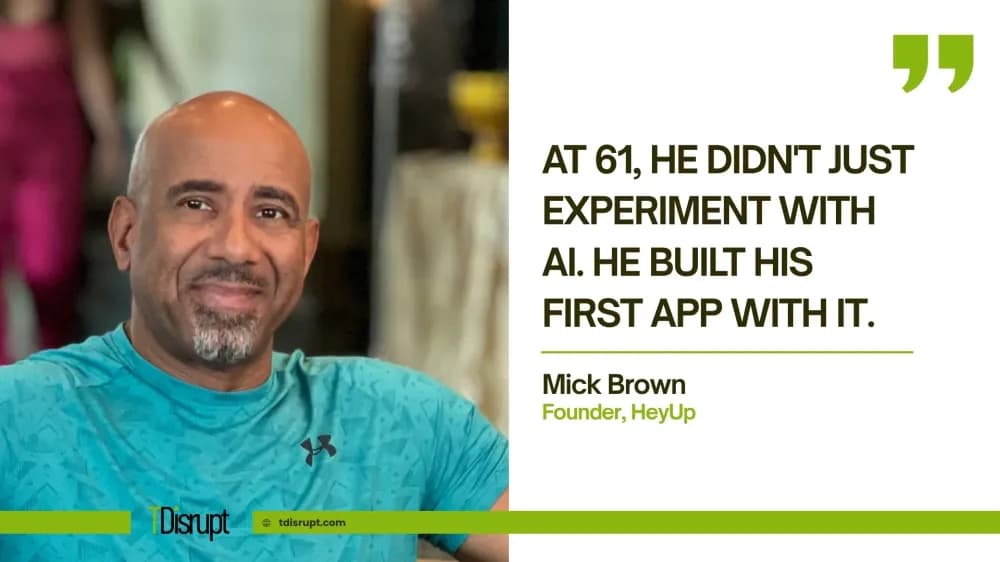
At 61, He Built His First App With AI. He Had Never Written Code Before.
A former Sheffield plasterer with no software development background turned a personal fitness idea into a published app using artificial intelligence. Mick Brown's journey from construction work to the Apple App Store shows how AI is opening technology entrepreneurship to people who once lacked the technical skills or resources to participate.
Key Takeaways
- 01At 61, former plasterer Mick Brown built his first application despite having no previous software development experience.
- 02AI tools, including Claude and Codex, helped him work with Swift and Xcode, while he retained responsibility for product decisions and testing.
- 03HeyUp turns sedentary time into short movement breaks, with private on-device repetition counting.
- 04His journey illustrates how AI can lower entry barriers for entrepreneurs whose expertise comes from outside the technology industry.
Michael “Mick” O’Neil Brown spent a decade working as a plasterer in Sheffield, England. More than four decades later, at 61, he accomplished something he had never imagined doing: building and launching his own iPhone application.
He had never developed software. He had no programming background, no conventional development team and no substantial technology budget. What he did have was an idea, years of practical experience and a willingness to learn something entirely unfamiliar.
Today, the 62-year-old Toronto resident is the founder of HeyUp: Daily Movement Breaks, a wellness application designed to help people become more active through short, manageable exercises during everyday routines.
His story is about more than a career reinvention. It reflects an emerging shift in technology: artificial intelligence is beginning to give people outside the software industry a practical way to turn their own ideas into working products.
From Sheffield to Building Something New
Brown grew up around Sheffield's Hyde Park Flats, where he delivered newspapers before attending City School and eventually entering the plastering trade. At 27, he moved to Canada, building a career across telecommunications sales, real estate and entrepreneurship.
Software engineering was never part of that journey.
The idea behind HeyUp emerged from a more personal challenge. As Brown entered his mid-50s, he became increasingly conscious of declining muscle strength and the importance of staying physically independent with age.
During a stay in Playa del Carmen, Mexico, he and his wife, Darlene, found themselves without access to a gym. Instead of abandoning exercise, they began doing simple bodyweight movements together.
On another hotel stay, they started using a phone timer to interrupt long periods of sitting with brief exercises.
That experience led to a simple observation: people might not need to find another hour for exercise. They could make better use of the minutes already available.
Brown carried the concept for more than a year. Building an application, however, seemed financially and technically out of reach.
Then generative AI changed what he could attempt.
AI Became His Bridge Into Software Development
Rather than hiring a traditional development team, Brown began experimenting with AI-assisted programming tools while teaching himself Apple's Xcode development environment.
In an earlier CanadianSME interview, he identified Claude and Codex among the AI tools that helped him create HeyUp.
These systems could generate Swift code, explain unfamiliar programming concepts and assist with troubleshooting. Brown provided the product vision, decided how features should work and tested the results.
The first functioning version emerged during roughly one intensive week. Getting the application ready for release involved further work across camera functionality, interface design, subscriptions, privacy requirements and App Store submission.
Brown does not suggest that AI instantly made him an experienced engineer.
“AI lowered the technical barrier, but I still had to bring the idea, make the decisions, test it and keep learning.”
That distinction matters. AI did not eliminate the work of building software. It allowed someone without formal programming experience to participate directly in work that previously seemed beyond his reach.
For nontechnical entrepreneurs, that could significantly change the economics of early product development. A founder can potentially create and test an initial application before committing to a larger engineering team, although production quality, security and maintenance still require careful attention.
Brown's experience illustrates that possibility at a personal level.
HeyUp: A Simple Idea Turned Into a Real Product
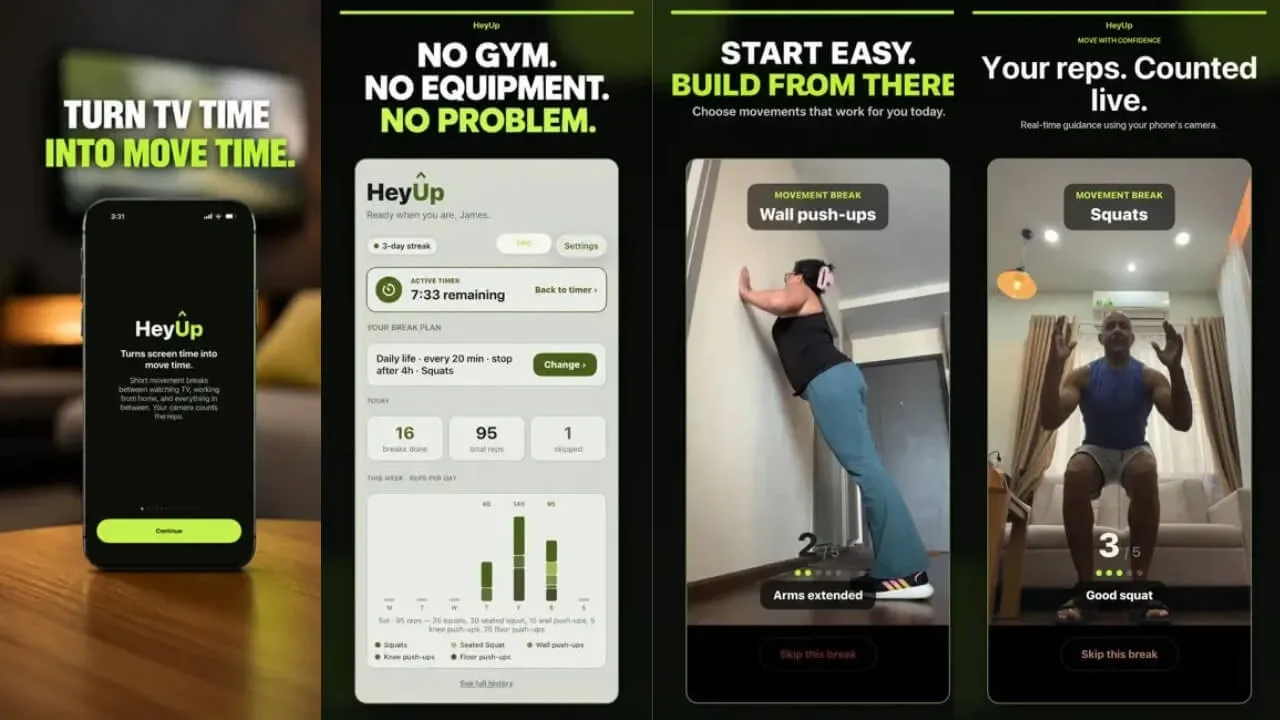
HeyUp launched on the Apple App Store in July 2026.
Its approach is deliberately simple. Users schedule short movement breaks while watching television, working from home or going about their day. They choose an exercise, set a manageable repetition target and gradually track their progress.
Movements include wall push-ups, knee push-ups, standard push-ups, chair stands and seated exercises designed for people with different mobility levels.
One of its more technically interesting features uses Apple's on-device body-pose detection to count repetitions through the camera. According to HeyUp, the camera footage is neither recorded nor uploaded, allowing movement counting to happen locally.
The app records completed exercises, repetitions and progress. It currently offers introductory and limited weekly free movement breaks, with paid options for expanded access. Its availability has also expanded beyond the original iPhone release to supported iPads and Macs.
The underlying fitness philosophy has support beyond Brown's personal experience. The World Health Organization's physical activity guidance encourages people to reduce sedentary time and begin with manageable amounts of movement, although HeyUp itself has not been independently shown to produce specific clinical outcomes.
What Mick Brown's Journey Says About the Future of AI
The most significant part of Brown's story may not be the application itself, but who was able to build it.
For decades, software entrepreneurship generally required programming knowledge, access to experienced developers or enough funding to hire them.
AI-assisted coding is beginning to weaken some of those barriers.
A teacher with an education idea, a tradesperson with a workflow problem or an older entrepreneur with decades of industry experience can now explore building software without first becoming a professional programmer.
That does not mean technical expertise is obsolete. AI-generated code can contain errors, introduce security weaknesses and create systems that become difficult to maintain. A working prototype is also not evidence of commercial success.
HeyUp remains a young, self-funded product. Its long-term adoption, retention and financial performance are not yet established publicly.
But the application exists, and its founder's experience demonstrates something meaningful: programming experience is no longer necessarily the first requirement for experimenting with a software business.
Brown is continuing to improve HeyUp based on user feedback, with accessibility, additional movements and broader platform support among his priorities.
At an age when many people begin considering retirement, he has instead entered an entirely new field.
There is a striking parallel between the philosophy behind his application and the way he built it. HeyUp encourages people to start with small movements rather than waiting until they feel ready for a full workout. Brown approached software development much the same way: learning incrementally, working through unfamiliar problems and improving what he had created.
His journey does not establish that anyone can build a successful technology company simply by asking AI to write code.
It establishes something more credible and potentially more important.
Experience outside technology can be the starting point for creating technology. And at 61, having never written software before, Mick Brown found a way to begin.
Readers can explore HeyUp's official website or find HeyUp: Daily Movement Breaks on the Apple App Store.
Sources & References
- HeyUp: Daily Movement Breaksheyup.fit
- CanadianSME interviewcanadiansme.ca
- Apple App Storeapps.apple.com
- World Health Organization's physical activity guidancewho.int
About the author
TDisrupt's editorial desk covering artificial intelligence, startups, blockchain, infrastructure and enterprise technology.